All posts and comments have been imported.
Visit the new site here:
http://turn3.freelief.com/
Wednesday, February 11, 2009


Wednesday, February 4, 2009
David Eggert, you ignorant ass.
Yes, I'm angry.
Shouldn't journalists report the truth?
Why doesn't a writer for Associated Press check facts? Did he even Google the case before submitting this?
This allegation, first published nearly two years ago, has been proven false.
While there were some horses that were underweight, most notably a mare who had been very sick, vets testified that 56 horses were in ideal or better weight.
There was hay and water on the premises, proven by the prosecution's own photos. There were witnesses who testified that the defendant bought hay from them.
How hard would it have been to look into this, Dave?
Instead, we have the following "news" outlets reporting your untrue allegation:
I expect a correction.
XP
P.S. Where possible, I am adding in the comments:
I'm ashamed that [news source] is recycling misinformation from March 2007. These horses were not tortured. They had food and water. There was medicine and dewormer; this is all documented. Review the testimony for yourself: http://turn3vsjcac.blogspot.com/
It is important to note that Jackson County combined separate groups of horses, allowing very young horses to become impregnated *after* the seizure, allowing Elvis to be trampled *after* the seizure which was the direct cause for his euthanasia, sold horses with massive parasite loads and unkempt hooves 6-8 months *after* the seizure and even sold a number of them to "kill buyers" who ship horses to slaughterhouses in Canada.
That's not rescue. The public has the right to know.
Shouldn't journalists report the truth?
Why doesn't a writer for Associated Press check facts? Did he even Google the case before submitting this?
"Authorities in March 2007 discovered 69 malnourished horses without food or water on a farm in Jackson County."
This allegation, first published nearly two years ago, has been proven false.
While there were some horses that were underweight, most notably a mare who had been very sick, vets testified that 56 horses were in ideal or better weight.
There was hay and water on the premises, proven by the prosecution's own photos. There were witnesses who testified that the defendant bought hay from them.
How hard would it have been to look into this, Dave?
Instead, we have the following "news" outlets reporting your untrue allegation:
- Detroit Free Press [link]
- WLAJ, MI [link]
- ConnectMidMichigan.com [link]
- Battle Creek Enquirer, MI [link]
- WILX-TV, MI [link]
- Lansing State Journal, MI [link]
- Fox 28, IN [link]
- WLNS, MI [link]
- MLive.com [link]
- and probably more not yet indexed
I expect a correction.
XP
P.S. Where possible, I am adding in the comments:
I'm ashamed that [news source] is recycling misinformation from March 2007. These horses were not tortured. They had food and water. There was medicine and dewormer; this is all documented. Review the testimony for yourself: http://turn3vsjcac.blogspot.com/
It is important to note that Jackson County combined separate groups of horses, allowing very young horses to become impregnated *after* the seizure, allowing Elvis to be trampled *after* the seizure which was the direct cause for his euthanasia, sold horses with massive parasite loads and unkempt hooves 6-8 months *after* the seizure and even sold a number of them to "kill buyers" who ship horses to slaughterhouses in Canada.
That's not rescue. The public has the right to know.
Recycling BS
I think I will just call an article "compost" if it recycles erroneous information like this:
My comment:
I'm ashamed that the Lansing State Journal is recycling misinformation from March 2007. These horses were not tortured. They had food and water. There was medicine and dewormer; this is all documented. Review the testimony for yourself: http://turn3vsjcac.blogspot.com/
It is important to note that Jackson County combined separate groups of horses, allowing very young horses to become impregnated *after* the seizure, allowing Elvis to be trampled *after* the seizure which was the direct cause for his euthanasia, sold horses with massive parasite loads and unkempt hooves 6-8 months *after* the seizure and even sold a number of them to "kill buyers" who ship horses to slaughterhouses in Canada.
That's not rescue. The public has the right to know.
P.S. For that matter, the Michigan Court of Appeals written judgment was likewise "compost" -- the same old disproved arguments of the prosecution touted as fact.
Court reinstates charges against horse farm [link]
Midday update
DAVID EGGERT • Associated Press • February 4, 2009 • From LSJ.com
The Michigan Court of Appeals has reinstated felony torture charges against two horse farm operators.
Authorities in March 2007 discovered 69 malnourished horses without food or water on a farm in Jackson County. The horses were found amid piles of trash, rusted auto parts and manure.
A three-judge panel released an opinion Wednesday finding probable cause to bind over James Henderson Jr. and Matthew Mercier for trial. A circuit judge had ruled there was no evidence that the defendants intended to harm horses.
The appeals court also reversed a lower court and ordered the farm's owner to forfeit his herd.
Messages seeking comment have been left with attorneys for the two defendants.
My comment:
I'm ashamed that the Lansing State Journal is recycling misinformation from March 2007. These horses were not tortured. They had food and water. There was medicine and dewormer; this is all documented. Review the testimony for yourself: http://turn3vsjcac.blogspot.com/
It is important to note that Jackson County combined separate groups of horses, allowing very young horses to become impregnated *after* the seizure, allowing Elvis to be trampled *after* the seizure which was the direct cause for his euthanasia, sold horses with massive parasite loads and unkempt hooves 6-8 months *after* the seizure and even sold a number of them to "kill buyers" who ship horses to slaughterhouses in Canada.
That's not rescue. The public has the right to know.
P.S. For that matter, the Michigan Court of Appeals written judgment was likewise "compost" -- the same old disproved arguments of the prosecution touted as fact.
Not the end.
It's not over.
Don't think that this ruling will end the fight for justice in this case.
Jackson County should not have seized the horses. The problems were minor, common, fixable and being addressed. Animal control made things far worse with their inept handling of the herd.
Never forget that Elvis was trampled to death after the seizure.
Never forget Summer or the other horses loaded onto trailers bound for slaughter in Canada after the public livestock auctions.
That's not rescue.
Court of Appeals overturns Jackson County judges in Grass Lake horse abuse case [link]
by Steven Hepker | Jackson Citizen Patriot
Wednesday February 04, 2009, 10:38 AM
The Michigan Court of Appeals has reversed two Jackson County Circuit Court judges and reinstated criminal and civil cases against a Grass Lake horse farm.
The ruling Tuesday came just three weeks after oral arguments in Prosecutor Hank Zavislak's appeal.
In the civil case, Circuit Judge Thomas Wilson overturned District Judge Joseph Filip's forfeiture of 69 horses owned by James Henderson Jr. Wilson determined forfeiture was improper because Henderson was an absentee owner and did not have direct control of the animals.
The appeals court ruled that because Henderson owned the horses and leased the farm in E. Michigan Avenue, and care of the horses, pastures and pens were inadequate, the forfeiture was correct.
The appeals court also reinstated three felony counts of animal torture against Henderson and farm manager Matthew Mercier. Circuit Judge Chad Schmucker dismissed the charges, saying the evidence did not establish the three animals in question were tortured.
Don't think that this ruling will end the fight for justice in this case.
Jackson County should not have seized the horses. The problems were minor, common, fixable and being addressed. Animal control made things far worse with their inept handling of the herd.
Never forget that Elvis was trampled to death after the seizure.
Never forget Summer or the other horses loaded onto trailers bound for slaughter in Canada after the public livestock auctions.
That's not rescue.
Tuesday, January 13, 2009
Turn 3 case continues in court of appeals
Members of the self-titled Turn 3 Army drove down ice-covered highways to show their support for Matt Mercier and James Henderson as the Michigan Court of Appeals heard opening arguments.
Court of appeals hears arguments in Grass Lake horse case [link]
Steven Hepker | Jackson Citizen Patriot | Jan. 13, 2009James Henderson said he did not visit his Grass Lake horse farm in the first quarter of 2007.
Jackson County Assistant Prosecutor Jerrold Schrotenboer argued Tuesday that a jury should get to decide if some of his animals were tortured in that time either intentionally or as the result of "conscious disregard."
"The torture statute is a general-intent statute," Schrotenboer argued before the Michigan Court of Appeals in Detroit. "The Circuit Court got it wrong."
In other words, torture can involve active participation or inaction.
Circuit Judge Chad Schmucker last year dismissed animal-torture charges against Henderson and farm manager Matthew Mercier. In a parallel civil case, Circuit Judge Thomas Wilson overturned a ruling by District Judge Joesph Filip that ordered Henderson to forfeit his herd of 60-plus horses to the county.
Although charges involved just three horses, the county seized the entire herd in March 2007 and eventually sold them at auction for a fraction of what Henderson claimed they were worth. About 80 horses sold for $50,000.
Defense attorney Michael Dungan said Henderson did not consciously disregard medical problems with the three horses because he was not aware of them.
Henderson was an absentee owner and Mercier ran day-to-day operations, he said.
That's what I've seen so far in the media. Will update with witnesses' accounts of the first day in court when supporters return home and send updates.
Friday, November 14, 2008
We're looking for your testimonials.
In my inbox yesterday, as a result of a mass email from another Turn 3 Army member, I received this testimonial.
I not only think everyone should read it, but if you have a personal experience to share involving this case, I'd like to hear from you, too.
This is exactly the kind of material that is needed to share and forward that will help spread the word about this case and motivate others to get involved. Thanks, Gerry.
To get involved, e-mail your letter to xpbuttercup@gmail.com and jdocpony@yahoo.com so we can share more testimonials with the public.
May the good you do today benefit us all tomorrow.
I not only think everyone should read it, but if you have a personal experience to share involving this case, I'd like to hear from you, too.
Horse friends and associates;
Last spring I emailed many (if not all) of you when the media frenzy covering the seizure of horses in Grass Lake broke and I realized that I personally knew Matt Mercier, one of the young men charged in the case. Having shown with him at Spur of the Moment Horse Shows; having seen his horses, their willing attitude and affection for him; their healthy condition and witnessed first hand his consideration for his horses... the belief I shared in my email—that the charges being brought against these young men were not only suspect, but had to be inherently wrong—was validated several months ago.
If you have not been following the continued Grass Lake horse seizure—or been enlightened—the front page of the Farm Bureau newsletter disclosed earlier this year that all charges were dropped against Matt Mercier and Jim Henderson. Subsequent court decisions concluded the seizure was conducted without any basis in fact, and the return of their horses and property (or value) was ordered. However, Matt and Jim are still subjected to animosity from the uneducated public because the mass media has not sensationalize the truth like it did the falsehood.
With the charges dropped, rather than owning up and acknowledging they made a serious mistake, Jackson County Animal Control—using our public donation and tax dollars intended to provide for needy animals—is now taking a different direction to circumvent making restitution and admitting their actions were completely, totally and irresponsibly WRONG. Now, they are pursuing legal steps that jeopardize anyone who owns livestock. The results could give animal "shelters" more power and autonomy to make subjective decisions for privately owned farms and how we provide for our animals, and justify (and absolve) their misconduct in the Grass Lake seizure or the repeat of such.
Livestock and farm owners have to galvanize into action before this goes back to court in January! If WE don't keep people with limited knowledge about our animals and farms from making more arbitrary decisions and laws FOR us, the farms and horses that are lost tomorrow will be our own. Please contribute a few minutes of your time to write a letter; forward contact information for helpful sources for others to send letters to, and forward this email to your horse and farm associates for OUR mutual protection!
SINCERELY,
Gerry Eaton
This is exactly the kind of material that is needed to share and forward that will help spread the word about this case and motivate others to get involved. Thanks, Gerry.
To get involved, e-mail your letter to xpbuttercup@gmail.com and jdocpony@yahoo.com so we can share more testimonials with the public.
May the good you do today benefit us all tomorrow.
Monday, November 10, 2008
No excuse: Ag groups must act now.
I was at three of the four public auctions of "Turn 3 Ranch" horses held in 2007, after seeing photos from the first one. I was absolutely appalled at the condition of the horses that had been in Jackson County's care for at least six months:
Fecal tests done by new owners showed that the horses suffered from as many as three different kinds of intestinal parasite, in numbers great enough to kill the horse if not dewormed with the utmost care. This indicates that regular deworming did NOT occur under the county's watch.
I didn't trust what I was hearing when this case first went public—didn't know anyone on either side—so I read the pre-trial hearing transcripts for myself. While conditions at the farm were truly not ideal, neither were they abuse.
To see abuse, you need to look at what the county's actions did to the defendants' lives. Read what the media reported based on what county officials told them.
This case is a nightmare for farmers. The agricultural community better wake up, and quick.
Think about it. National case law could be made in Michigan in January 2009. Are you ready?
- There was NO EXCUSE for the horses to be long overdue for hoof care, with the dollar amount that Animal Control demanded for their basic needs.
- There was NO EXCUSE for the weanlings—born after the farm was seized—to be bloated from an obvious parasite infestation, with their bones sticking out through dull, fuzzy coats a clear indication that those distended bellies were not "fat" by any means.
- There was NO EXCUSE for yearlings and two-year-old fillies to be bred for spring 2008 foals, which also clearly happened during the months that the county was "in charge" of the herd.
Fecal tests done by new owners showed that the horses suffered from as many as three different kinds of intestinal parasite, in numbers great enough to kill the horse if not dewormed with the utmost care. This indicates that regular deworming did NOT occur under the county's watch.
I didn't trust what I was hearing when this case first went public—didn't know anyone on either side—so I read the pre-trial hearing transcripts for myself. While conditions at the farm were truly not ideal, neither were they abuse.
To see abuse, you need to look at what the county's actions did to the defendants' lives. Read what the media reported based on what county officials told them.
- What manner of animal lives for six months without food or water?
- Who claims there are 30 pregnant mares, when only a month or two before foaling, it is clear to any knowledgeable farmer what is a developing foal and what is a "hay belly"? (Only about a dozen mares were actually pregnant, and the fact that they carried to term indicates they received adequate care during their pregnancy.)
- Who perjures themselves and says there was no food or water available, in order to seize the property, when their own photographs and testimony later entered prove that food and water WAS available?
This case is a nightmare for farmers. The agricultural community better wake up, and quick.
- How would it affect YOU if keeping livestock in muddy spring fields was considered animal cruelty? Does every cow in your herd need an individual stall and a clean blanket?
- How would it affect YOU if every scratch, cut or cough had to be appraised and treated by a veterinarian or you could be considered guilty of a felony?
- How would it affect YOU if wire fencing were banned for large animals? If a neighbor with a vendetta opens your gate at night, should you lose the right to own animals?
Think about it. National case law could be made in Michigan in January 2009. Are you ready?
Tuesday, November 4, 2008
Date set for appeal.
News today in the Cit Pat:
Farm Bureau and others, where is your amicus brief in support of Michigan farmers adhering to the Right To Farm Act?
Where is the public outrage over the documented mistreatment of the horses at the hands of incompetent county staff and untrained volunteers?
Where is the outcry over the county selling these "rescued" horses to meat buyers at auction, with the inevitable destination of slaughter in Canada?
Why should the owners face felony animal cruelty charges in the death of a horse trampled under the "care" of Jackson County, weeks after the farm was seized?
Get the facts. Don't believe me, read the transcripts yourselves. Interview the witnesses at the auctions. Do not assume your government is there to protect you. Indeed, take action to protect yourself from your government.
I'm XP, and I approve this message.
Appeals court to hear horse forfeiture case
Steven Hepker, Jackson Citizen Patriot | Nov. 4, 2008
Attorneys will argue the Grass Lake Township horse case on Jan. 13 before the Michigan Court of Appeals.
Jackson County Assistant Prosecutor Jerrold Schrotenboer said Monday the appeals court set oral arguments in the case of Jackson County vs. James Henderson and Matthew Mercier.
At issue is the court-ordered forfeiture of Henderson's large herd of horses at his farm on Page Avenue.
The American Humane Association, the Michigan State Bar Animal Law Section and Leelanau Horse Rescue filed amicus briefs supporting the appeal.
District Judge Joseph Filip ordered the county to sell the animals in July 2007, four months after Jackson County Animal Control seized more than 60 horses on allegations of abuse.
Circuit Judge Thomas Wilson in May overturned Filip's ruling in the civil forfeiture case.
In the related criminal matter, Circuit Judge Chad Schmucker dismissed animal-torture charges against Henderson and Matthew Mercier.
Jackson County Prosecutor Hank Zavislak appealed both rulings.
Henderson owned the farm and Mercier managed it. Schmucker determined Henderson was an absentee owner who did not handle day-to-day operations in the winter of 2006-07.
Eventually, after foaling season, the county sold nearly 80 horses for about $50,000 at three auctions.
Henderson plans to sue the county for lost horses and lost income.
He was fired as a probation officer in Washtenaw County last summer because of his legal problems.
Oral arguments will pit Schrotenboer against defense attorney Michael Dungan of Jackson.
Farm Bureau and others, where is your amicus brief in support of Michigan farmers adhering to the Right To Farm Act?
Where is the public outrage over the documented mistreatment of the horses at the hands of incompetent county staff and untrained volunteers?
Where is the outcry over the county selling these "rescued" horses to meat buyers at auction, with the inevitable destination of slaughter in Canada?
Why should the owners face felony animal cruelty charges in the death of a horse trampled under the "care" of Jackson County, weeks after the farm was seized?
Get the facts. Don't believe me, read the transcripts yourselves. Interview the witnesses at the auctions. Do not assume your government is there to protect you. Indeed, take action to protect yourself from your government.
I'm XP, and I approve this message.
Monday, September 22, 2008
Farmers rights at risk. Will you stand?
Once again, it is time to step up and take action.
Keep it going.
I'm counting on fellow supporters to run with this. Contact your local Farm Bureau office with a copy of this letter, and any supporting information from this blog.
(Permission granted. Copy and disseminate freely.)
Join the Farm Bureau and make sure they know you are joining because of this case (always best to put it in writing) and that you expect their support of these Michigan farmers to ensure it doesn't happen to you or your neighbor next time.
Case of seized horses threatens rights [link]
Jackson Citizen Patriot | Sep. 20, 2008
SPRINGPORT — Jackson County Animal Control overstepped its bounds when it seized 69 horses at a Grass Lake farm more than a year ago. A judge agreed, but the county appealed.
We should show support for the farmers whose property was wrongfully taken and sold. Why? Because the dangerous precedent this case will set if the county prevails puts us all at risk.
To seize the farm, officials claimed the horses had no food or water, but submitted photos into evidence showing this was untrue. Experts testified most of the valuable herd was near ideal body condition.
Adequate food and shelter — per Michigan Department of Agriculture recommendations — was provided. The Right to Farm Act should have protected the owners from overzealous officers and an ignorant judge who wrongly allowed the county to auction the horses away for pennies per pound.
Testimony also indicates Jackson County failed to provide adequate care. A wounded filly, Ice, did not receive proper veterinary attention. Elvis, a young paint, was euthanized.
Judges this spring dismissed torture charges, found the forfeiture improper and ordered the owner reimbursed for the animals and lost income. Prosecutors waste taxpayer money by appealing those rulings.
Worse, radical groups like People for the Ethical Treatment of Animals are watching. A new ruling could adversely affect farmers by setting unfriendly case law and giving authorities overreaching power to seize property with little or no evidence.
With national attention focused on this appeal, state agriculture organizations must act to support the rights of Michigan farmers.
If you value your personal property rights, urge Michigan Farm Bureau to file an amicus brief in support of James Henderson and Matthew Mercier, owner and manager of Turn 3 Ranch. For more on this case, visit Turn3Justice.com.
— Shantell Coats
Keep it going.
I'm counting on fellow supporters to run with this. Contact your local Farm Bureau office with a copy of this letter, and any supporting information from this blog.
(Permission granted. Copy and disseminate freely.)
Join the Farm Bureau and make sure they know you are joining because of this case (always best to put it in writing) and that you expect their support of these Michigan farmers to ensure it doesn't happen to you or your neighbor next time.
Tuesday, September 16, 2008
Another reason you should care.
If it can happen to Turn 3 Ranch, it can happen to you.
Here is a news article about another alleged neglect case:
Couple face animal cruelty charges
Read the comments ... there are pages of them!
Then visit this site: www.painterdefensefund.com
I'm waiting for more details on this case, but it sounds more and more like another improper seizure from what information I have been receiving.
Here is a news article about another alleged neglect case:
Couple face animal cruelty charges
Read the comments ... there are pages of them!
Then visit this site: www.painterdefensefund.com
I'm waiting for more details on this case, but it sounds more and more like another improper seizure from what information I have been receiving.
Thursday, September 4, 2008
Why should anyone care?
A CitPat reader questions the concern over national lobbying interests' involvement in the Turn 3 case:
We care, Mary, because of the rights of agricultural families that have been stripped by ignorant but powerful and well-funded animal rights organizations, whose supporters may be several generations removed from the farming life.
Apparently you weren't in court when one of the female animal control officers asserted she would not hesitate to use deadly force against the defendant(s) ... I believe this was just before the case was thrown out due to lack of evidence that the personal protection order (wrongfully obtained, by the way) had been violated.
These officers lied under oath and it was proven. They, for lack of a better word, STOLE over $500,000 worth of horses from the defendants and the horses were in worse condition after the farm was seized—also proven. How can you defend these actions?
Association's role defended on horse case [link]
RIVES JUNCTION — Why are some people upset that the American Humane Association filed a brief in the county horses case? I looked up the definition of an amicus brief in a law book and it says, "to call the court's attention to some matter which might otherwise escape its attention. To aid the court in gaining information to make a proper decision ..."
AHA was just protecting the integrity of a statute involving animals. [Really? Have you read the brief?] It is the only more conservative national organization that works hard to protect both children and animals.
The outcome of this case will affect other animal cruelty/neglect cases and so that is rightly its concern. Don't we allow freedom of speech in Jackson County?
One of the suspects was fined by the court for using a sexual slur against one of our female animal-control officers as reported by this paper. What kind of people defend suspects who would do something like that? [If we're commenting on "alleged" remarks, what kind of people would make references to one's sexual orientation as if it were material to the charges? Pretty sure that's illegal.]
— Mary Ganson
We care, Mary, because of the rights of agricultural families that have been stripped by ignorant but powerful and well-funded animal rights organizations, whose supporters may be several generations removed from the farming life.
Apparently you weren't in court when one of the female animal control officers asserted she would not hesitate to use deadly force against the defendant(s) ... I believe this was just before the case was thrown out due to lack of evidence that the personal protection order (wrongfully obtained, by the way) had been violated.
These officers lied under oath and it was proven. They, for lack of a better word, STOLE over $500,000 worth of horses from the defendants and the horses were in worse condition after the farm was seized—also proven. How can you defend these actions?
Thursday, August 28, 2008
More on Right to Farm.
What is Right to Farm?
from michigan.gov/mda
Why is this important?
According to the act, if a farm is found to be the subject of complaints, they should only have to show evidence that they are complying with GAAMPs, or if they are found to not be in compliance, they should be given thirty (30) days to comply.
From P.A. 93:
What are the GAAMPs for equines in Michigan?
You can view the full Generally Accepted Agricultural and Management Practices document at michigan.gov/mda under Care of Farm Animals.
A few excerpts:
from michigan.gov/mda
The Right to Farm Act affects everyone. Michigan agriculture is a $37.5 billion industry involving every county of the state. A wide variety of crop and livestock production strengthens our farm economy and helps to enhance the natural environment.View the Right to Farm Act.
The Michigan Right to Farm Act, P.A. 93, was enacted in 1981 to provide farmers with protection from nuisance lawsuits. This state statute authorizes the Michigan Commission of Agriculture to develop and adopt Generally Accepted Agricultural and Management Practices (GAAMPs) for farms and farm operations in Michigan. These voluntary practices are based on available technology and scientific research to promote sound environmental stewardship and help maintain a farmer's right to farm.
Why is this important?
According to the act, if a farm is found to be the subject of complaints, they should only have to show evidence that they are complying with GAAMPs, or if they are found to not be in compliance, they should be given thirty (30) days to comply.
From P.A. 93:
Sec. 4.
(1) ... the director shall investigate all complaints involving a farm or farm operation, including, but not limited to, complaints involving the use of manure and other nutrients, agricultural waste products, dust, noise, odor, fumes, air pollution, surface water or groundwater pollution, food and agricultural processing by-products, care of farm animals and pest infestations. Within 7 business days of receipt of the complaint, the director shall conduct an on-site inspection of the farm or farm operation.
(3) If the director finds ... that the person responsible for a farm or farm operation is using generally accepted agricultural and management practices, the director shall notify, in writing, that person, the complainant, and the city, village, or township and the county in which the farm or farm operation is located of this finding. If the director identifies that the source or potential sources of the problem were caused by the use of other than generally accepted agricultural and management practices, the director shall advise the person responsible for the farm or farm operation that necessary changes should be made to resolve or abate the problem and to conform with generally accepted agricultural and management practices and that if those changes cannot be implemented within 30 days, the person responsible for the farm or farm operation shall submit to the director an implementation plan including a schedule for completion of the necessary changes.
What are the GAAMPs for equines in Michigan?
You can view the full Generally Accepted Agricultural and Management Practices document at michigan.gov/mda under Care of Farm Animals.
A few excerpts:
Horses need to be adequately fed to maintain their body weight and health; however, idleness, overfeeding and obesity are undesirable and often harmful... Nutritional demands are usually met with good quality, properly harvested forages and pastures... Horses utilize hay or other roughages more efficiently than do other non-ruminants...
As a rule, horse owners can obtain adequate housing for their horses with uninsulated buildings. Healthy horses with adequate diet and good body condition only require protection from the wind. Pastures should have adequate shelter where horses can get out of the sun, wind, rain, and other inclement weather. These may include, but are not limited to, open barns, lean-to's, constructed windbreaks and woodlots.
Common fencing materials are wood, pipe, PVC, electrical wire or tape, smooth, non-electrical wire, rubber belt and woven wire. Bands of horses may be housed in open sheds.
Tuesday, August 26, 2008
Before and after photos.
Before the seizure. After the seizure.
Plus:
More photos to come.
Still looking for current photos of Turn 3 Ranch horses so that we can confirm those that are safe and alive versus the many eye-witness reports of these "rescued" horses going to kill buyers and being sent to slaughter in Canada.
So far only those sympathetic to the plight of the defendants have stepped forward and offered photos of the horses they bought in order to ensure good homes for these improperly seized horses, some clearly in worse condition when purchased from auction than when seized from Turn 3.
You may remain anonymous if you like, and do not have to give your location. We just want a current photo of an identifiable animal that was part of the Turn 3 Ranch case for peace of mind... to know that just one more "unknown fate" was not the abattoir.
Plus:
More photos to come.
Still looking for current photos of Turn 3 Ranch horses so that we can confirm those that are safe and alive versus the many eye-witness reports of these "rescued" horses going to kill buyers and being sent to slaughter in Canada.
So far only those sympathetic to the plight of the defendants have stepped forward and offered photos of the horses they bought in order to ensure good homes for these improperly seized horses, some clearly in worse condition when purchased from auction than when seized from Turn 3.
You may remain anonymous if you like, and do not have to give your location. We just want a current photo of an identifiable animal that was part of the Turn 3 Ranch case for peace of mind... to know that just one more "unknown fate" was not the abattoir.
Regarding felony animal torture: Moose
One of three felony animal torture counts is related to a horse named Moose.
February 2007—Mercier noticed that Moose had dropped about fifty pounds. Mercier brought Moose into the barn where she would be warmer, would not have to compete for food, and he could keep a close eye on her and control her diet.
Moose stressed out from being separated from a "buddy" horse and would not eat much. She began to colic, and ate even less food. Mercier provided Moose with supplements and supportive care. Moose recovered from the colic, but had difficulty putting weight back on because of the cold weather (supported by testimony).
March 14—ACO Wheaton found Moose segregated with the other thin horses in the barn.
March 16—Dr. Sray found Moose standing in a pen with two other thin horses. He did not observe anything about the three horses that led him to suspect torture or failure to provide. He believed that the low body weight of Moose and the other two thin horses were due to common factors such as age, weather and sickness.
March 20—Dr. Altemose and Dr. Chickering found Moose to be emaciated and recommended immediate veterinary treatment, which was not provided by Animal Control until March 27.
March 21—Brad Chaltry examined Moose and noted that she was “really skinny” but walking around. She was in the same pen as two other thin horses. He did not find her starved, and believed she needed to be dewormed. He did not recommend veterinary care for Moose.
March 27—Dr. Hammer examined Moose and found no medical problems, but noted that she was “severely emaciated.” The prosecution’s expert did not find a need for veterinary care for this horse.
Moose was a “hard keeper” that had difficulty keeping weight on during the winter for a
variety of reasons. She put on weight when the weather warmed up, and was sold at auction by Jackson County.
February 2007—Mercier noticed that Moose had dropped about fifty pounds. Mercier brought Moose into the barn where she would be warmer, would not have to compete for food, and he could keep a close eye on her and control her diet.
Moose stressed out from being separated from a "buddy" horse and would not eat much. She began to colic, and ate even less food. Mercier provided Moose with supplements and supportive care. Moose recovered from the colic, but had difficulty putting weight back on because of the cold weather (supported by testimony).
March 14—ACO Wheaton found Moose segregated with the other thin horses in the barn.
March 16—Dr. Sray found Moose standing in a pen with two other thin horses. He did not observe anything about the three horses that led him to suspect torture or failure to provide. He believed that the low body weight of Moose and the other two thin horses were due to common factors such as age, weather and sickness.
March 20—Dr. Altemose and Dr. Chickering found Moose to be emaciated and recommended immediate veterinary treatment, which was not provided by Animal Control until March 27.
March 21—Brad Chaltry examined Moose and noted that she was “really skinny” but walking around. She was in the same pen as two other thin horses. He did not find her starved, and believed she needed to be dewormed. He did not recommend veterinary care for Moose.
March 27—Dr. Hammer examined Moose and found no medical problems, but noted that she was “severely emaciated.” The prosecution’s expert did not find a need for veterinary care for this horse.
Moose was a “hard keeper” that had difficulty keeping weight on during the winter for a
variety of reasons. She put on weight when the weather warmed up, and was sold at auction by Jackson County.
Regarding felony animal torture: Elvis
One of three felony animal torture counts is related to a horse named Elvis.
Check out the Turn 3 Ranch Photo Albums on Facebook to see pictures of Elvis, a young horse that was critically injured during and after the seizure, allowed to suffer without vet care for weeks, and then finally euthanized after being trampled.
Court documents show that while Elvis presented with a minor limp prior to the seizure, the complications that manifested after the horses were mismanaged by Jackson County Animal Control led to his death.
March 14—ACO Wheaton on site and did not see any signs of discomfort with Elvis.
March 15—Mercier first notices Elvis has a limp.
March 16—ACO Wheaton on site and did not see any signs of discomfort with Elvis. He is examined by Dr. Sray, who testified the horse was not showing hip pain or discomfort, but some weakness or soreness on the right. Mercier has appointment for Dr. Irving to examine Elvis and Ice that afternoon. Mercier later forced to reschedule for March 21 due to extended meeting with ACO Wheaton.
March 20—Mercier forced to vacate premises that morning. ACO Wheaton on site during the day, did not see any signs of discomfort with Elvis. Dr. Altemose and Dr. Chickering examined horses and farm, and did not offer testimony regarding Elvis’ injury. ACO Dunlap canceled March 21 appointment. Despite Dr. Sray's recommendation, no veterinarian care was provided by Animal Control until March 27.
March 20—ACO Wheaton first noticed that Elvis was “dragging his leg” when he passed in front of the headlights of a truck during the late evening hours. ACO Wheaton was not concerned and felt it appropriate to monitor the horse.
March 21—ACO Wheaton checked on Elvis and did not notice any obvious problems other than the limp. Brad Chaltry examined Elvis and noticed that he had a "really sore back leg" he did not want to move around on.
March 27—Dr. Hammer examined Elvis and described him as “severely lame" ... "the horse was very sore on the hip" ... "almost to the point of refusing to move.”
March 27 through April 10—Prosecution offers no testimony relative to Elvis' condition or treatment during this time.
April 11—Elvis suddenly taken to MSU by Leelanau Horse Rescue personnel, examined by Dr. Marteniuk. MSU is told he was found on the ground and initially thought to be dead, recumbent and needed assistance to rise. It was believed that Elvis had been trampled by the seventeen horses in the group.
Animal Control had been in charge of the farm and the horses for three weeks. According to testimony, he was not critically injured at the time the farm was seized. However, the prosecution claims the defendants are responsible for felony animal torture with regard to Elvis' condition.
Elvis was euthanized at MSU, and Dr. Kurt Williams performed a necropsy. He found that Elvis was suffering from osteochondrosis, a poorly understood degenerative disease of the bones. This condition would render Elvis more likely to be injured by other horses.
Contrary to the testimony given about Elvis’s condition from March 20 through April 11, Dr. Williams testified that Elvis should have been acting severely lame prior to April 11.
This information would lead an intelligent person to conclude that Animal Control failed to provide adequate veterinary care, or even to notice the horse was suffering for weeks. The secondary injury was likely sustained during the seizure on March 20, where it is alleged that volunteers mixed segregated groups of horses which often leads to fighting and kicking.
Check out the Turn 3 Ranch Photo Albums on Facebook to see pictures of Elvis, a young horse that was critically injured during and after the seizure, allowed to suffer without vet care for weeks, and then finally euthanized after being trampled.
Court documents show that while Elvis presented with a minor limp prior to the seizure, the complications that manifested after the horses were mismanaged by Jackson County Animal Control led to his death.
March 14—ACO Wheaton on site and did not see any signs of discomfort with Elvis.
March 15—Mercier first notices Elvis has a limp.
March 16—ACO Wheaton on site and did not see any signs of discomfort with Elvis. He is examined by Dr. Sray, who testified the horse was not showing hip pain or discomfort, but some weakness or soreness on the right. Mercier has appointment for Dr. Irving to examine Elvis and Ice that afternoon. Mercier later forced to reschedule for March 21 due to extended meeting with ACO Wheaton.
March 20—Mercier forced to vacate premises that morning. ACO Wheaton on site during the day, did not see any signs of discomfort with Elvis. Dr. Altemose and Dr. Chickering examined horses and farm, and did not offer testimony regarding Elvis’ injury. ACO Dunlap canceled March 21 appointment. Despite Dr. Sray's recommendation, no veterinarian care was provided by Animal Control until March 27.
March 20—ACO Wheaton first noticed that Elvis was “dragging his leg” when he passed in front of the headlights of a truck during the late evening hours. ACO Wheaton was not concerned and felt it appropriate to monitor the horse.
March 21—ACO Wheaton checked on Elvis and did not notice any obvious problems other than the limp. Brad Chaltry examined Elvis and noticed that he had a "really sore back leg" he did not want to move around on.
March 27—Dr. Hammer examined Elvis and described him as “severely lame" ... "the horse was very sore on the hip" ... "almost to the point of refusing to move.”
March 27 through April 10—Prosecution offers no testimony relative to Elvis' condition or treatment during this time.
April 11—Elvis suddenly taken to MSU by Leelanau Horse Rescue personnel, examined by Dr. Marteniuk. MSU is told he was found on the ground and initially thought to be dead, recumbent and needed assistance to rise. It was believed that Elvis had been trampled by the seventeen horses in the group.
Animal Control had been in charge of the farm and the horses for three weeks. According to testimony, he was not critically injured at the time the farm was seized. However, the prosecution claims the defendants are responsible for felony animal torture with regard to Elvis' condition.
Elvis was euthanized at MSU, and Dr. Kurt Williams performed a necropsy. He found that Elvis was suffering from osteochondrosis, a poorly understood degenerative disease of the bones. This condition would render Elvis more likely to be injured by other horses.
Contrary to the testimony given about Elvis’s condition from March 20 through April 11, Dr. Williams testified that Elvis should have been acting severely lame prior to April 11.
This information would lead an intelligent person to conclude that Animal Control failed to provide adequate veterinary care, or even to notice the horse was suffering for weeks. The secondary injury was likely sustained during the seizure on March 20, where it is alleged that volunteers mixed segregated groups of horses which often leads to fighting and kicking.
Regarding felony animal torture: Ice
One of three felony animal torture counts is related to a horse named Ice.
March 14—ACO Wheaton did not observe any wire in the wound. Mercier testified that Ice was injured 7-10 days prior. At that time, Mercier removed a wire wrapped around Ice's leg, and treated the wound with bandages and antibiotics. The wound initially improved, but then worsened. Mercier made an appointment with Dr. Irving for March 16.
March 15—ACO Wheaton did not observe any wire in the wound.
March 16—ACO Wheaton did not observe any wire in the wound. Mercier forced to cancel appointment for Ice with Dr. Irving due to time spent with ACO Wheaton, rescheduled for March 21. Dr. Sray did not observe any wire in the wound, but recommended immediate veterinary care for the injury.
March 20—Mercier forced to vacate premises that morning. ACO Wheaton did not observe any wire in the wound. Dr. Altemose and Dr. Chickering (MSU veterinarians) did not observe any wire in the wound during their examination. Despite Dr. Sray's advice that the injury receive immediate veterinary care, ACO Dunlap cancels March 21 appointment with Dr. Irving for Ice's injury. Veterinary care was not provided by Animal Control until March 27.
March 21—Brad Chaltry examined the wound, cleaned and treated it. He did not observe any wire in the wound.
March 27—Dr. Hammer examined Ice's leg and described the injury as the most severe on the farm. He observed wire sticking out 1-1/2 inches, and testified that anyone should have been able to see it and that it was impossible for the wire to have worked its way out from the inside.
Dr. Hammer's testimony leaves an intelligent person to believe that wire became embedded in Ice's wound after the farm was seized on March 20. However, it was used to support a felony animal torture charge against the defendants.
April 18—Dr. Irving examined Ice and found the wound healed and Ice recovering. He testified that the wound should have been treated prior to Dr. Hammer's examination on March 27.
Ice fully recovered and was sold at auction by Jackson County.
March 14—ACO Wheaton did not observe any wire in the wound. Mercier testified that Ice was injured 7-10 days prior. At that time, Mercier removed a wire wrapped around Ice's leg, and treated the wound with bandages and antibiotics. The wound initially improved, but then worsened. Mercier made an appointment with Dr. Irving for March 16.
March 15—ACO Wheaton did not observe any wire in the wound.
March 16—ACO Wheaton did not observe any wire in the wound. Mercier forced to cancel appointment for Ice with Dr. Irving due to time spent with ACO Wheaton, rescheduled for March 21. Dr. Sray did not observe any wire in the wound, but recommended immediate veterinary care for the injury.
March 20—Mercier forced to vacate premises that morning. ACO Wheaton did not observe any wire in the wound. Dr. Altemose and Dr. Chickering (MSU veterinarians) did not observe any wire in the wound during their examination. Despite Dr. Sray's advice that the injury receive immediate veterinary care, ACO Dunlap cancels March 21 appointment with Dr. Irving for Ice's injury. Veterinary care was not provided by Animal Control until March 27.
March 21—Brad Chaltry examined the wound, cleaned and treated it. He did not observe any wire in the wound.
March 27—Dr. Hammer examined Ice's leg and described the injury as the most severe on the farm. He observed wire sticking out 1-1/2 inches, and testified that anyone should have been able to see it and that it was impossible for the wire to have worked its way out from the inside.
Dr. Hammer's testimony leaves an intelligent person to believe that wire became embedded in Ice's wound after the farm was seized on March 20. However, it was used to support a felony animal torture charge against the defendants.
April 18—Dr. Irving examined Ice and found the wound healed and Ice recovering. He testified that the wound should have been treated prior to Dr. Hammer's examination on March 27.
Ice fully recovered and was sold at auction by Jackson County.
Definition of torture may be distorted for prosecution's benefit.
As stated earlier, this case carries national ramifications for all livestock owners.
I hope the legislative champions for the agriculture industry in Michigan and in the nation are poised to file their own briefs in this case. Someone must stand up for the Right to Farm Act.
Colic can occur in any horse barn, and often causes a drastic and sudden weight loss. Horses in accommodations that are essentially "padded stalls" can find ways to injure themselves. Neither of these should be grounds for the government to seize and sell $500,000 worth of personal property.
National Humane Group Files Brief in Michigan Horse Abuse Case
Pat Raia | Aug 26, 2008
The American Humane Association (AHA) has filed an amicus brief with the Michigan Court of Appeals in connection with a controversial animal cruelty case involving Matt Mercier and James Henderson Jr., of Grass Lake, a move that is designed to provide background information or perspective that might contribute to a court decision.
Mercier and Henderson were charged with felony animal torture charges and one count of misdemeanor animal abuse in March 2007 after authorities seized 69 horses owned by Henderson from a ranch operated by Mercier. Those charges were dropped in April 2008 when Jackson County Circuit Court Judge Chad C. Schmucker ruled that neither intended to harm the horses. The AHA filed the brief after the Michigan Court of Appeals agreed to hear arguments that felony charges be reinstated. Misdemeanor charges are still pending.
Jackson County Chief Appellate Attorney Jerrold Schrotenboer said the brief, filed on Aug. 18, does not speak to specifics of the case, nor the individuals involved. "The brief gives the court information to consider the case in a different light," he said. "My case is about Michigan's animal cruelty law and how it is applied. The brief gives a national perspective."
Amicus briefs, often called "friend of the court" briefs, which contain relevant matter not already brought to the attention of the Court, are commonly filed in connection with appeals cases. Individuals or groups filing such briefs must not be directly connected with the case, but must have knowledge or perspective of value to the court.
According to Allie Phillips, AHA director of Public Policy, the brief addresses directly the intent portion of Michigan's animal cruelty statute. "Michigan law speaks to general--not specific--intent," she said.
However, Henderson's attorney, Michael Dungan, said the brief contains no new information.
"I didn't see anything different from the prosecution's case," Dungan said. "I don't think it will make a difference in both the civil or criminal case."
Phillips said she became aware of the case via the Michigan Bar Association, for which she is a council member. She consulted with Schrotenboer before filing the brief. "The American Humane Association will never insert itself into a case without first talking with local prosecutors," she said.
The Michigan Bar Association's Animal Law section has also entered a motion to file an amicus brief regarding the case, Schrotenboer said. Details were unavailable.
Mercier's attorney, Susan Meinsberg, was unavailable for comment.
I hope the legislative champions for the agriculture industry in Michigan and in the nation are poised to file their own briefs in this case. Someone must stand up for the Right to Farm Act.
Colic can occur in any horse barn, and often causes a drastic and sudden weight loss. Horses in accommodations that are essentially "padded stalls" can find ways to injure themselves. Neither of these should be grounds for the government to seize and sell $500,000 worth of personal property.
We're going national, too.
Get on & hang on.

Join the Facebook Group: Support Turn 3 Ranch
Become a Fan of the Facebook Page: Turn 3 Ranch
Support the Facebook Cause: Support Turn 3 Ranch
Join the Facebook Group: Support Turn 3 Ranch
Become a Fan of the Facebook Page: Turn 3 Ranch
Support the Facebook Cause: Support Turn 3 Ranch
Friday, August 22, 2008
David, meet Goliath.
The update I told you was forthcoming ... still trying to get a copy of the brief that American Humane Association sent in. My comments in brackets, red. [XP]
Incredible. Who are they going to call for back-up next, PETA? Oh, that would be fun times.
Maybe the defendants should be calling MythBusters ... as Jackson County is having a difficult time facing the reality that what they did was wrong.
More to come.
Animal rights groups join Jackson Co. horse case appeals [link]
Hepker/Quisenberry | Aug 22, 2008
Two big guns have joined Jackson County in its legal fight over the 2007 seizure of a herd of horses in Grass Lake and related torture allegations.
The Denver-based American Humane Association this week filed a brief backing prosecutors in the Michigan Court of Appeals case against Turn-3 Ranch owner James Henderson and farm manager Matthew Mercier.
The animal-law section of the Michigan Bar Association also plans to file a similar amicus brief.
"It is very, very unusual for outside groups to file an amicus brief in criminal appeals at the Court of Appeals level," Jackson County Assistant Prosecutor Jerrold Schrotenboer said.
Both organizations are interested in the case because the court is to make a decision on how the state's animal torture statute is to be interpreted, which could have far-reaching consequences, lawyers affiliated with the organizations said. [XP—I do believe that is the point we have been stressing to the agricultural community for more than a year ... what affects Turn 3 may one day affect YOU.]
"States look to each other as to how they interpret laws. Michigan really has been a leader in animal-protection laws," said Allie Phillips, who heads the Washington, D.C., office of the American Humane Association, a national nonprofit organization working to prevent cruelty, abuse, neglect and exploitation of children and animals. "If Michigan comes up with this interpretation, other states could follow."
Jackson County prosecutors have argued the law does not require that anyone accused of breaking it intended specific harm to an animal.
Prosecutors appealed after two Jackson County Circuit Court judges dropped felony torture charges and ruled the county must pay economic damages that include the value of more than 80 horses sold at auctions.
Court action in Jackson County is on hold until the Court of Appeals rules. It could be spring before the case is heard, Schrotenboer said. There are more than 2,000 pages of transcripts that the Court of Appeals must sort through.
At issue is the civil case, in which District Judge Joseph Filip ordered Henderson to forfeit his horses, and the criminal matter involving alleged torture. The cases are combined in the Court of Appeals.
Mary Chartier, chairwoman of the litigation committee of the bar association's animal law section, said it is most important the law is "interpreted in a manner consistent with the wording and the legislators' intent."
Michael Dungan, a Jackson attorney representing Henderson, reiterated his Circuit Court arguments that the prosecution could not prove horses were tortured, and that Henderson was an absentee owner who had not visited the farm during the time in question in early 2007.
Dungan is part of a defense team that includes civil attorney Richard Ginsberg of Ann Arbor and state appellate defender Susan Meinberg of Detroit.
Mercier, who has not been able to find farm work, asked for a public defender.
Dungan said the addition of the Michigan Bar and the American Humane group won't help what he considers a weak appeal. Their briefs only seconded points made by Schrotenboer, Dungan said. [XP—Choosing to be ignorant of both sides of a case, judging based on the words of one side. Brilliant.]
"Obviously, they were not in court and did not read the transcripts," Dungan said. "They basically said, 'Yeah, what Jerry said.' "
Circuit Judge Chad Schmucker on April 30 dropped three charges of felony animal torture, saying there was no evidence Henderson or Mercier intended to harm three horses found injured, too thin or lame in March 2007. [XP—Kudos, Judge Schmucker.]
Circuit Judge Thomas Wilson later overturned Filip's decision, ruled the forfeiture was improper. By then, Jackson County Animal Control had dispersed the entire herd at auctions in Jackson, Lenawee and Ingham counties. [XP—Kudos, Judge Wilson. Oh, and JCAC did not disperse all of the horses at auction ... do the math.]
The county took control of 69 horses in March 2007. With births that spring, the herd grew to more than 80.
Henderson said the horses were worth $500,000 — 10 times the actual sale totals. Henderson was fired in July from his longtime job as a probation agent in Washtenaw County. [XP—directly related to the appeal extending this case past his available leave time.]
Mercier sent an e-mail message to supporters this week advising that the animal rights group had teamed with the county.
"They will take this to the U.S. Supreme Court if they have to. We are up against big money and high-powered lawyers now," Mercier said.
Schrotenboer said the outside agencies are not funding the appeal by Jackson County and that the others aren't likely to present oral arguments.
Incredible. Who are they going to call for back-up next, PETA? Oh, that would be fun times.
Maybe the defendants should be calling MythBusters ... as Jackson County is having a difficult time facing the reality that what they did was wrong.
More to come.
Wednesday, August 20, 2008
What neglected horses look like.
* NONE of these horses are from the Turn 3 Ranch.
ALL of the photos were found on news sites or captured from news video. They involve recent cases—most of them still open, with charges pending, that have not yet gone to trial.
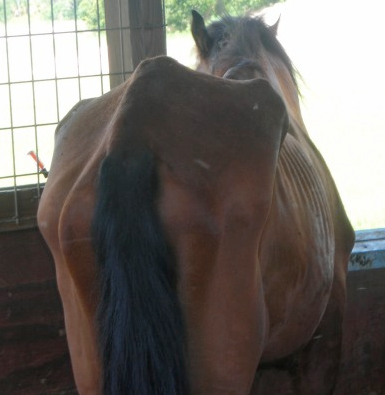
This is apparent, alleged neglect. Open case in Florida.
See the pronounced dip between the spine and hip?
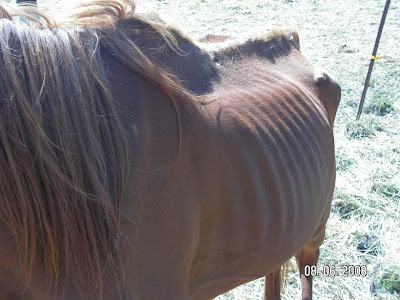
This is apparent, alleged neglect. Open case in Oregon.
NOTE: Authorities seized the three malnourished horses
and did not seize the four healthy horses.

This is apparent, alleged neglect. Open case in Michigan.
NOTE: Authorities seized this malnourished mare
(who has no teeth, by the way) and also four other horses;
however, the other horses seized appear healthy.
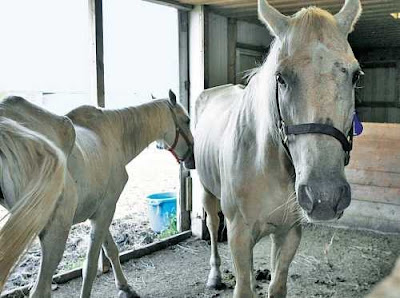
Open case in New York.
The horse on the left is malnourished.
The horse on the right is underweight.
Can you see the difference? I can point out several.
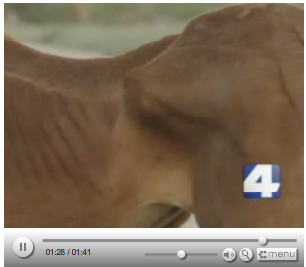
This is emaciated. Open case in New Mexico.
Allegedly abandoned in this condition.
I have never seen a horse this bad, ever.
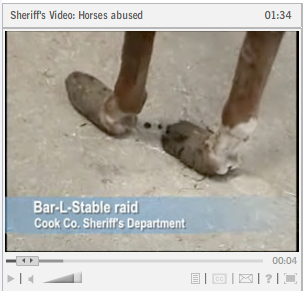
This is apparent, alleged neglect. Open case in Illinois.
This does not happen overnight.
The horse could barely move and was destroyed.
If someone is guilty of intentionally neglecting horses, they should face the consequences.
If someone is struggling to care for their horses and needs help, they should get assistance.
If someone is caring for their horses and meeting their needs, taking action to treat disease and injury, they should not be treated as animal torturers.
XP
ALL of the photos were found on news sites or captured from news video. They involve recent cases—most of them still open, with charges pending, that have not yet gone to trial.
This is apparent, alleged neglect. Open case in Florida.
See the pronounced dip between the spine and hip?
This is apparent, alleged neglect. Open case in Oregon.
NOTE: Authorities seized the three malnourished horses
and did not seize the four healthy horses.
This is apparent, alleged neglect. Open case in Michigan.
NOTE: Authorities seized this malnourished mare
(who has no teeth, by the way) and also four other horses;
however, the other horses seized appear healthy.
Open case in New York.
The horse on the left is malnourished.
The horse on the right is underweight.
Can you see the difference? I can point out several.
This is emaciated. Open case in New Mexico.
Allegedly abandoned in this condition.
I have never seen a horse this bad, ever.
This is apparent, alleged neglect. Open case in Illinois.
This does not happen overnight.
The horse could barely move and was destroyed.
If someone is guilty of intentionally neglecting horses, they should face the consequences.
If someone is struggling to care for their horses and needs help, they should get assistance.
If someone is caring for their horses and meeting their needs, taking action to treat disease and injury, they should not be treated as animal torturers.
XP
Subscribe to:
Posts (Atom)

